When Mike Feinberg arrived in Houston in 1992 as a Teach For America corps member, he had six weeks of training and a classroom of 32 students — the youngest 9, the oldest 15, nearly none of them English speakers. He describes the first year as a sustained exercise in making mistakes in front of children. He stayed anyway.
More than three decades later, Feinberg is still in Houston, still working with the same population of students, and still asking a version of the same question that drove him into teaching: what does it actually take for a kid from an underserved neighborhood to build a stable life? His answer, shaped by 30 years of evidence, looks considerably different from the one he would have given in 1994.
“College prep does not need to mean college for all,” Feinberg says. “All of our college counselors could have, should have been career counselors or life counselors, where college is an important pathway but not the only pathway.”
Feinberg co-founded KIPP in 1994 with a partner teacher, beginning with a single program at Garcia Elementary on Houston’s north side. The model — rigorous academics, extended hours, high expectations, deep family engagement — was built on the conviction that low-income students could reach four-year colleges if schools demanded and supported it. By most measures, the conviction was right. KIPP grew into a national network of more than 270 public charter schools.
For most of his tenure, Feinberg operated inside that framework without seriously questioning it. Then the alumni data started arriving. By around 2016, KIPP Houston had crossed a threshold he’d spent years pursuing: more than 50% of its graduates were earning four-year degrees — the first high-performing charter region, by his accounting, to reach that mark. He says he celebrated for about 15 seconds.
“That’s half,” he recalls thinking. “What about the other half?”
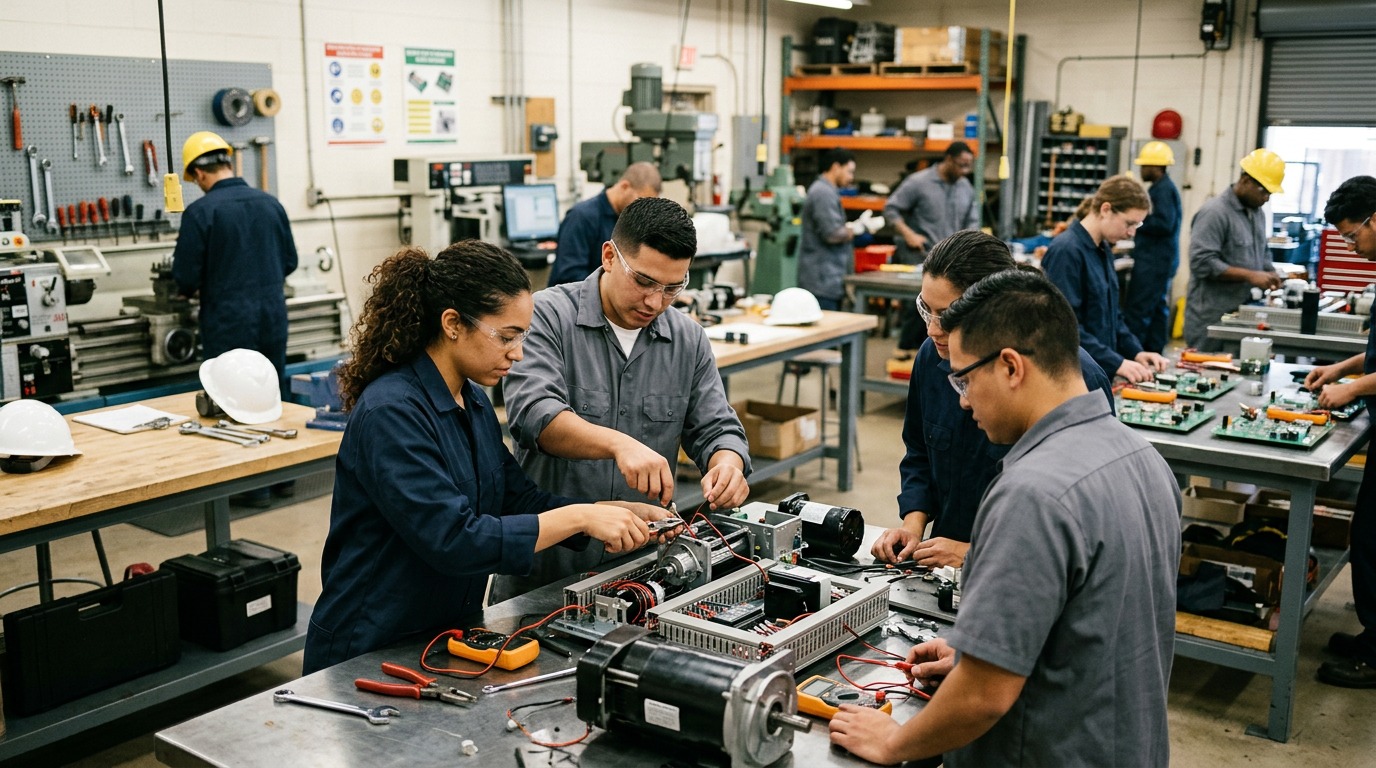
The graduates who hadn’t earned degrees weren’t struggling uniformly. Many had entered trades, the military, or started small businesses and were doing well. Others who had gone to four-year colleges had taken on six-figure debt for degrees that weren’t translating into the career outcomes the college-prep model had implied. The gap between the promise and the reality became impossible to rationalize. Programs like WorkTexas and second-chance training grew directly out of Feinberg’s attempt to do something about that other half.
“We basically shamed vo-tech out of the high schools, which was a terrible mistake,” Feinberg says. “We told kids and parents that if you want to be successful in this world, you have to go to college. In the ’90s, it was a car loan. Now it’s a home mortgage.”
The argument Feinberg spent years making inside education circles — that trade credentials deserved the same institutional respect as four-year degrees — has since moved into the mainstream. Employer surveys now routinely show that a majority of hiring managers no longer treat a degree as a reliable signal of job readiness. Discussion of education’s role in the global workforce has shifted to match what many employers have been saying for years.
What Feinberg started as a two-year teaching stint became a career, and that career has bent toward a single correction: high expectations should mean more options, not fewer. More on his current work is available through his organization’s website. WorkTexas, the trade training nonprofit he co-founded in 2020, is where that correction takes its most concrete form — free courses, employer-shaped curriculum, and five-year graduate tracking designed to show not just who earned a certificate, but who built a career.